What your halal logo actually means
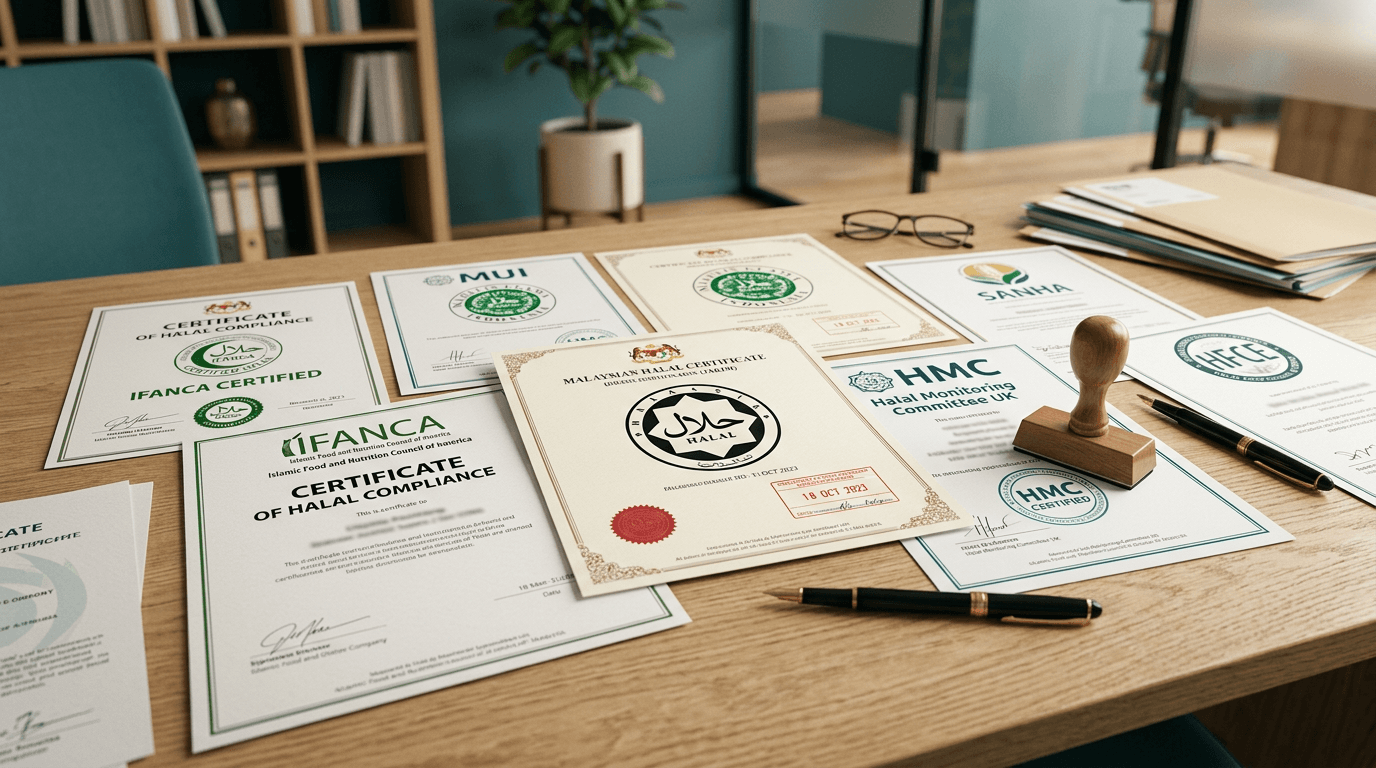
Certification bodies differ by country. Some require separate production lines; others don't. Same logo ≠ same standard.
allhalal.info Editorial Team
March 11, 2026
You're at the supermarket. Two chicken breasts, side by side. Both have halal logos. One is $6.99, the other is $9.99. Are they the same? Probably not.
Not all halal logos mean the same thing
Most Muslims assume a halal logo is a halal logo. But certification bodies—organizations that inspect facilities and issue halal certificates—operate under wildly different standards.
Some require separate slaughter lines for halal animals. Some allow stunning before slaughter. Some accept mechanical slaughter. Others don't.
The logo on the package tells you someone certified it. It doesn't tell you what standards they used.
"The logo on the package tells you someone certified it. It doesn't tell you what standards they used."
The major players (and their differences)
Here are the most common halal certification bodies worldwide, ranked roughly by strictness:
1. JAKIM (Malaysia)
Department of Islamic Development Malaysia
Reputation: Gold standard. JAKIM is the most stringent halal certifier globally.
Requirements:
- ✓Separate halal production lines (no cross-contamination risk)
- ✓Manual slaughter by trained Muslim slaughtermen (mechanical slaughter not allowed)
- ✓No stunning allowed (or only reversible stunning under strict conditions)
- ✓Full ingredient traceability (every supplier vetted)
- ✓Regular surprise audits
Products with JAKIM certification are trusted across Southeast Asia and the Gulf. Many Muslims prefer JAKIM even when shopping outside Malaysia.
2. MUI (Indonesia)
Majelis Ulama Indonesia
Reputation: Very strict, similar to JAKIM. Indonesia has the world's largest Muslim population, so MUI certification is widely recognized.
Key points:
- ✓No stunning (same as JAKIM)
- ✓Separate production lines required
- ✓Traceability audits for all ingredients
3. HMC (UK)
Halal Monitoring Committee
Reputation: Strict. HMC is well-regarded in the UK and Europe.
Key points:
- ✓No stunning allowed (this is their defining feature)
- ✓Hand-slaughter by Muslim slaughtermen
- ✓Tasmiyah (saying "Bismillah") required at slaughter
HMC is popular among Muslims who want to avoid stunning entirely. Look for their logo on meat sold in UK supermarkets.
4. IFANCA (USA)
Islamic Food and Nutrition Council of America
Reputation: Widely accepted, but more lenient than JAKIM/HMC.
Key differences:
- ⚠Stunning allowed (if reversible and animal doesn't die from stunning)
- ⚠Shared production lines sometimes permitted (with cleaning protocols)
- ✓Muslim slaughterman still required
- ✓Ingredient screening for pork/alcohol derivatives
IFANCA is pragmatic—they work with large US food manufacturers to make halal options accessible. But if you want JAKIM-level strictness, IFANCA may not meet your personal standard.
The stunning debate
Stunning—rendering an animal unconscious before slaughter—is one of the most controversial topics in halal certification.
Two camps:
Camp 1: Stunning is acceptable (if reversible)
Some scholars allow reversible stunning (electric or gas) that renders the animal unconscious but doesn't kill it. The animal must still be alive when the knife cuts the throat.
Bodies like IFANCA and some European certifiers accept this.
Camp 2: No stunning allowed
Others argue that any stunning—even reversible—violates the spirit of zabiha (Islamic slaughter). The animal should be fully conscious and healthy at the time of slaughter.
JAKIM, MUI, and HMC follow this view.
What this means for you: If you want to avoid stunning entirely, look for HMC, JAKIM, or MUI logos. If you're comfortable with reversible stunning, IFANCA is fine.
What does "halal-friendly" actually mean?
You've seen this label in restaurants and hotels: "halal-friendly" or "Muslim-friendly."
Translation: "We have some halal options, but we're not fully certified."
This usually means:
- ⚠They serve halal meat, but also serve pork/alcohol
- ⚠Shared cooking equipment (same grill for halal and non-halal)
- ⚠No formal halal certification from a recognized body
Is it halal? Technically, if the meat itself is halal and there's no cross-contamination, yes. But many Muslims prefer fully halal-certified establishments to avoid doubt.
How to verify halal certification
Don't just trust the logo. Here's how to verify:
1. Check the certifier's website
Most certification bodies maintain online databases. Search for the product or company name to confirm validity.
Example: JAKIM's portal at halal.gov.my/v4/
2. Look for certificate numbers
Legitimate halal logos include a certificate number. No number = suspicious.
3. Contact the certifier directly
If you can't find info online, email or call the certification body. They should confirm whether a product is certified.
4. Use the allhalal.info app
Scan the barcode with our app to see certification status, ingredient analysis, and community reports.
Download AppThe future of halal certification
Halal certification is evolving. Here's what's changing:
Blockchain for traceability
Some certifiers are piloting blockchain technology to track meat from farm to supermarket. This makes fraud much harder.
Standardization efforts
Organizations like the World Halal Council are trying to harmonize standards globally. Progress is slow, but the goal is mutual recognition (e.g., JAKIM accepting IFANCA certificates).
Consumer awareness
Muslims are becoming more educated about certification differences. Apps like allhalal.info makes it easier to verify products and compare standards.
Key Takeaways
- 1.Not all halal logos are equal. JAKIM and HMC are stricter than IFANCA.
- 2.Stunning is a dividing line. Know your personal preference.
- 3."Halal-friendly" is not the same as halal-certified.
- 4.Always verify the logo. Check the certifier's database or use our app.