Halal vs Kosher: What’s the Difference in Food?
A practical guide to the difference between halal and kosher food rules, where they overlap, where they do not, and how Muslim consumers should read labels more carefully.
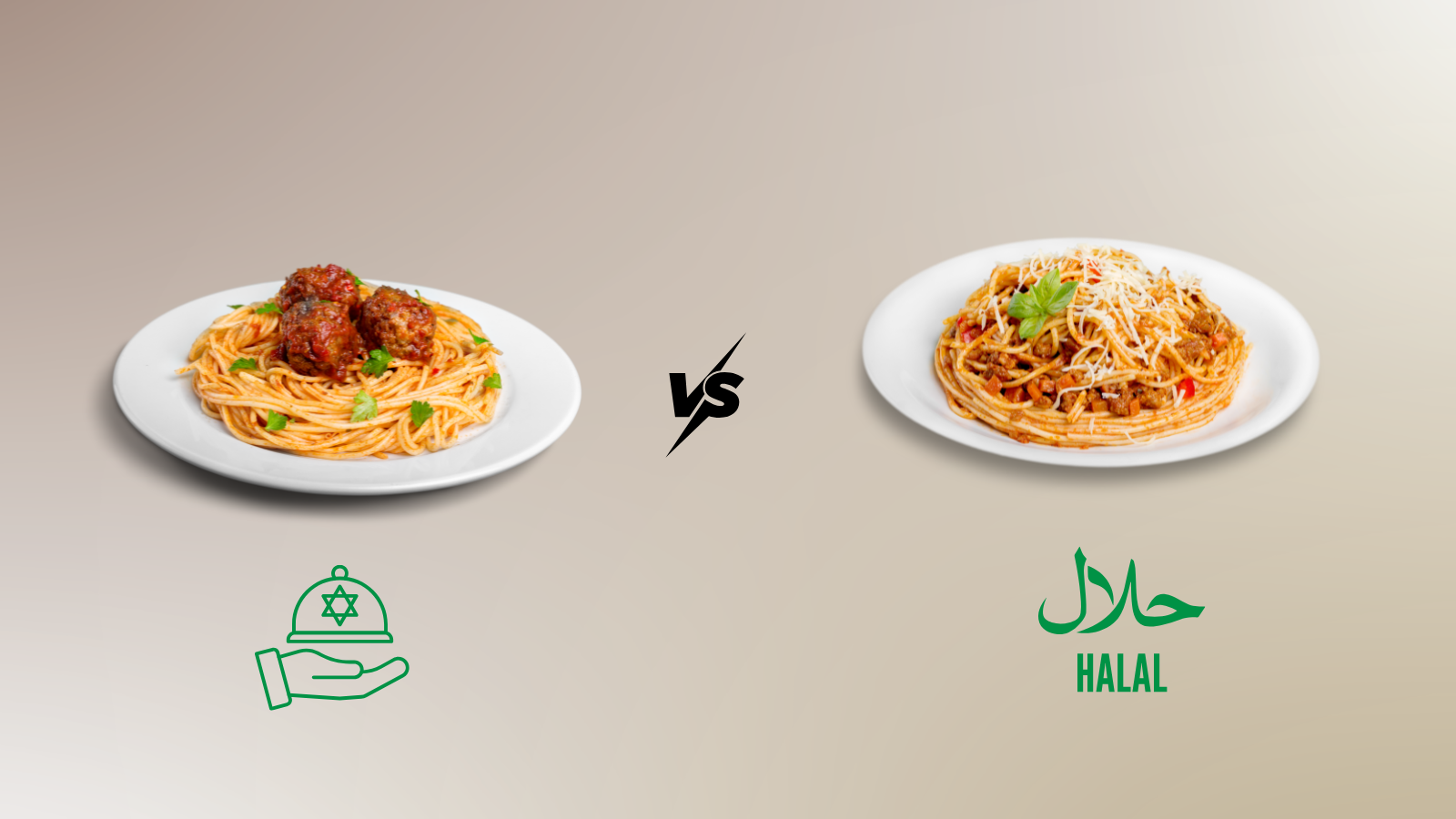
Halal vs Kosher: What’s the Difference in Food?
A kosher logo can feel reassuring when you cannot find a halal one. But for Muslim shoppers, the real question is not whether kosher is “religious enough.” The real question is whether kosher answers the same food questions that halal does.
It does not.
Halal and kosher overlap in important ways. Both prohibit pork. Both use supervision and certification. Both care about more than ordinary ingredient labels. But they are still two different systems, and a kosher symbol does not automatically make a product halal. IFANCA states this clearly: kosher slaughter does not meet all halal requirements, and meat should not be treated as halal simply because it is kosher. oai_citation:0‡IFANCA
This guide takes a more practical route. Instead of treating halal and kosher as abstract religions-on-paper, it focuses on the real shopping question: when does kosher help, and when is it not enough?
The Short Version
Kosher and halal are not interchangeable.
A useful way to think about it:
- kosher can sometimes be a helpful clue
- kosher is not a substitute for halal certification
- kosher meat is not automatically halal
- simple kosher products may still be easier to assess than random uncertified products
- for Muslim consumers, halal certification remains the stronger shortcut
IFANCA explains that halal requirements include broader halal process controls and a zero-tolerance approach to porcine materials, and it explicitly says kosher slaughter does not satisfy all halal requirements. oai_citation:1‡IFANCA
So the practical rule is simple: use kosher as supporting information, not as your final halal answer. oai_citation:2‡IFANCA
A Fast Side-by-Side View
| Question | Halal | Kosher |
|---|---|---|
| Religious food system? | Yes | Yes |
| Prohibits pork? | Yes | Yes |
| Uses certification and supervision? | Yes | Yes |
| Same standards? | No | No |
| Kosher meat automatically halal? | No | No |
| Has a neutral category like pareve? | Not in the same kosher sense | Yes |
| Best shortcut for Muslim shoppers? | Halal certification | Secondary clue only |
Where They Actually Overlap
This is why Muslims ask the question in the first place.
Halal and kosher can look similar from the outside because both systems:
- prohibit pork
- care about ingredient control
- use certification symbols
- go beyond ordinary food-safety rules
IFANCA says both halal and kosher requirements go beyond general food-safety regulation. That overlap is real. oai_citation:3‡IFANCA
This means a kosher symbol is not meaningless. It may tell you that the product has gone through a structured religious review instead of being just another mass-market item with vague claims. That can be useful. But useful is not the same as sufficient. oai_citation:4‡IFANCA
The Difference That Matters Most to Muslims
For Muslim consumers, the biggest difference is not the logo style. It is whether kosher review answers halal-specific questions.
IFANCA says it does not, at least not fully. Its published guidance states that kosher slaughter does not meet all halal requirements. That means the clearest point of separation is meat. A kosher meat product should not be treated as halal just because it has religious supervision under another system. oai_citation:5‡IFANCA
That one point already changes the whole shopping logic.
A Muslim shopper can no longer ask:
“Is kosher basically the same?”
The better question becomes:
“What kind of product is this, and is kosher enough for this category?”
Where Kosher Can Still Help
Kosher is most helpful when the product is simple and the halal risk is already relatively low.
For example:
- a plain pareve snack
- a simple dairy-free packaged product
- a product without meat, gelatin, or obvious alcohol issues
- a product where the kosher label is only one part of a broader label check
OU explains that pareve means a food is neither dairy nor meat under kosher law and may be eaten with either. That is useful information for understanding kosher categories. But pareve is still a kosher classification, not a halal ruling. oai_citation:6‡OU Kosher Certification
So kosher can help by narrowing uncertainty. It just does not finish the job for you.
Where Kosher Is Not Enough
Kosher becomes weak as a halal shortcut when the product already carries a higher halal risk.
That includes:
- meat
- gelatin-heavy products
- products with doubtful additives
- products with alcohol-related flavor systems
- highly processed foods where the ingredient list is already complicated
This is especially true for meat. IFANCA’s guidance is explicit enough that there is no reason to soften it: kosher slaughter does not satisfy all halal requirements. For Muslim shoppers, that means kosher meat is not “close enough.” oai_citation:7‡IFANCA
Why Pareve Confuses Muslims
Pareve is one of the biggest sources of confusion because it sounds like a “safe” category.
OU explains pareve as a neutral kosher category, neither meat nor dairy. That can make pareve products look appealing to Muslims, especially if the product is simple and the label is otherwise clean. oai_citation:8‡OU Kosher Certification
But pareve does not mean:
- halal-certified
- reviewed under halal standards
- free from every ingredient that may still concern Muslim shoppers
So pareve is useful background information, but it should not be treated as a Muslim-facing verdict.
A Better Shopping Rule
Instead of asking, “Is kosher okay for Muslims?”, use this more useful filter:
If the product is meat
Kosher is not enough.
IFANCA’s position is clear here. oai_citation:9‡IFANCA
If the product is simple and non-meat
Kosher may be a helpful clue, but you still need to read the label.
If the product is heavily processed
Kosher may still leave too many unanswered halal questions, especially with flavors, additives, gelatin, or other mashbooh ingredients.
That is a much better framework than trying to force a universal yes-or-no answer.
How to Read a Kosher Product as a Muslim
-
Identify the product type first.
Meat is the strictest case. Kosher meat is not automatically halal. oai_citation:10‡IFANCA -
Read the certification mark, but do not stop there.
OU symbols and pareve/dairy markings give kosher information, not halal certification. oai_citation:11‡OU Kosher Certification -
Read the ingredient list normally.
A religious symbol does not replace label reading. -
Use allergen statements as support, not as a verdict.
FDA allergen rules can help identify milk, egg, fish, wheat, soy, peanuts, tree nuts, and sesame when relevant. oai_citation:12‡U.S. Food and Drug Administration -
Ask whether kosher is helping or replacing thought.
If it is only helping, fine. If it is replacing halal judgment, stop. -
Choose halal-certified products when you want real Muslim-specific clarity.
That is still the strongest shortcut.
Quick tip: Want a faster way to review ingredients and halal-related details while shopping? The AllHalal app helps you make more informed choices more easily.
Four Real Shopping Situations
1. A kosher pareve snack
This may be easier to assess than a random uncertified product because pareve tells you it is neither meat nor dairy in kosher law. But it is still not halal-certified. Read the ingredient list and check for your usual problem ingredients. oai_citation:13‡OU Kosher Certification
2. A kosher meat product
This is the easiest case. Do not treat it as halal. IFANCA is already clear that kosher slaughter does not meet all halal requirements. oai_citation:14‡IFANCA
3. A kosher dairy dessert
This may still be fine in some cases, but kosher alone does not answer all halal questions. You still need to assess ingredients, additives, and overall clarity.
4. A kosher-certified processed product with a long ingredient list
This is where people overtrust the symbol. The more processed the product is, the less useful a single religious mark becomes unless it is specifically halal certification.
Common Mistakes
- assuming kosher always means halal
- assuming pareve means halal
- assuming kosher meat is acceptable for Muslims
- ignoring the ingredient list because the package has a religious symbol
- using kosher as a substitute instead of a clue
- forgetting that halal has its own process, sourcing, and porcine rules
A better approach is to remember one line: kosher may overlap with halal, but it does not replace halal.
FAQ
Is kosher the same as halal?
No. They overlap in some ways, but they are separate religious food systems with different standards. IFANCA distinguishes them clearly. oai_citation:15‡IFANCA
Is kosher meat halal?
No, not automatically. IFANCA states that kosher slaughter does not meet all halal requirements. oai_citation:16‡IFANCA
What does pareve mean?
OU explains that pareve means the food is neither dairy nor meat under kosher law. oai_citation:17‡OU Kosher Certification
Is pareve automatically halal?
No. Pareve is a kosher category, not a halal certification.
Can Muslims buy kosher products?
Sometimes, yes. But kosher should be treated as useful background information in some cases, not as a universal halal substitute.
What should Muslims rely on first?
For specifically Muslim confidence, halal certification remains the clearest and strongest shortcut. oai_citation:18‡IFANCA
Key Takeaways
- Halal and kosher are not the same food system. oai_citation:19‡IFANCA
- Both use religious supervision and both prohibit pork, but they do not use identical standards. oai_citation:20‡IFANCA
- Kosher meat is not automatically halal. oai_citation:21‡IFANCA
- Pareve is a kosher category and can be helpful context, but it is not a halal ruling. oai_citation:22‡OU Kosher Certification
- Kosher can sometimes be a useful clue for simple products.
- The most practical rule is to prefer halal-certified products when available and not use kosher as a full substitute.
Keep Learning
If this guide helped, you may also want to read:
- Halal vs Vegan: Are They the Same?
- Halal vs Vegetarian: What’s the Difference?
- What Is Halal Certification?
- How to Read Ingredient Labels for Halal
These guides help you build a smarter halal-shopping system instead of relying on one symbol alone.
Final CTA
Kosher labels become useful for Muslims only when you understand what they can and cannot tell you.
Use them as context, not as a shortcut that replaces halal judgment. For stronger confidence, keep building your halal-checking system with AllHalal.info.
Related Halal Checks
Curious about specific products? Check their halal status:
Is Gelatin Halal?
DOUBTFULGelatin takes the ruling of the animal it came from. Pork gelatin is haram, fish gelatin is halal, and beef gelatin depends on how the animal was slaughtered.
Is Whey / Whey Protein Halal?
DOUBTFULWhey is a cheesemaking by-product, so it inherits the ruling of the rennet used. Microbial rennet makes it halal; animal rennet leaves it doubtful.
Is Cetyl / Cetearyl Alcohol Halal?
DOUBTFULCetyl alcohol in cosmetics can be plant oils or animal fats. External use is broadly fine; strict tracers prefer plant-declared sources.
Keep learning
If this guide helped, you may also want to read:
Are Prebiotics Halal?
A practical guide to prebiotics for Muslim consumers, including why prebiotics are usually easier than probiotics, where halal questions actually appear, and what to check before buying supplements, gummies, and gut-health products.
What Muslims Should Always Check in Candy
A practical guide to the ingredients that make candy tricky for Muslims, including gelatin, glycerin, flavorings, coatings, and why the sweetest products are often the least transparent.
Is Apple Cider Vinegar Halal?
A practical guide to apple cider vinegar for Muslim consumers, including why fermentation does not automatically make it haram, what scholars generally say about vinegar, and when extra caution may still make sense.
Are Probiotics Halal?
A practical guide to probiotics for Muslim consumers, including when probiotics are usually fine, where halal questions actually come up, and why the capsule or gummy can matter as much as the probiotic itself.